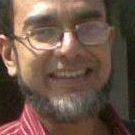
PROF DR.ABUL FAIZ SYED ABDUL AOWAL, DELHI COLLEGE OF ENGG,NEW DELHI (FAIZ MAMA)
DURING HIS GUWAHATI DAYS ( I am also in the Photo)
DURING HIS HOD, CIVIL , DCE & DEAN, DU DELHI DAYS
HIS 1650 GULABI BAGH DELHI OFFICIAL QUARTER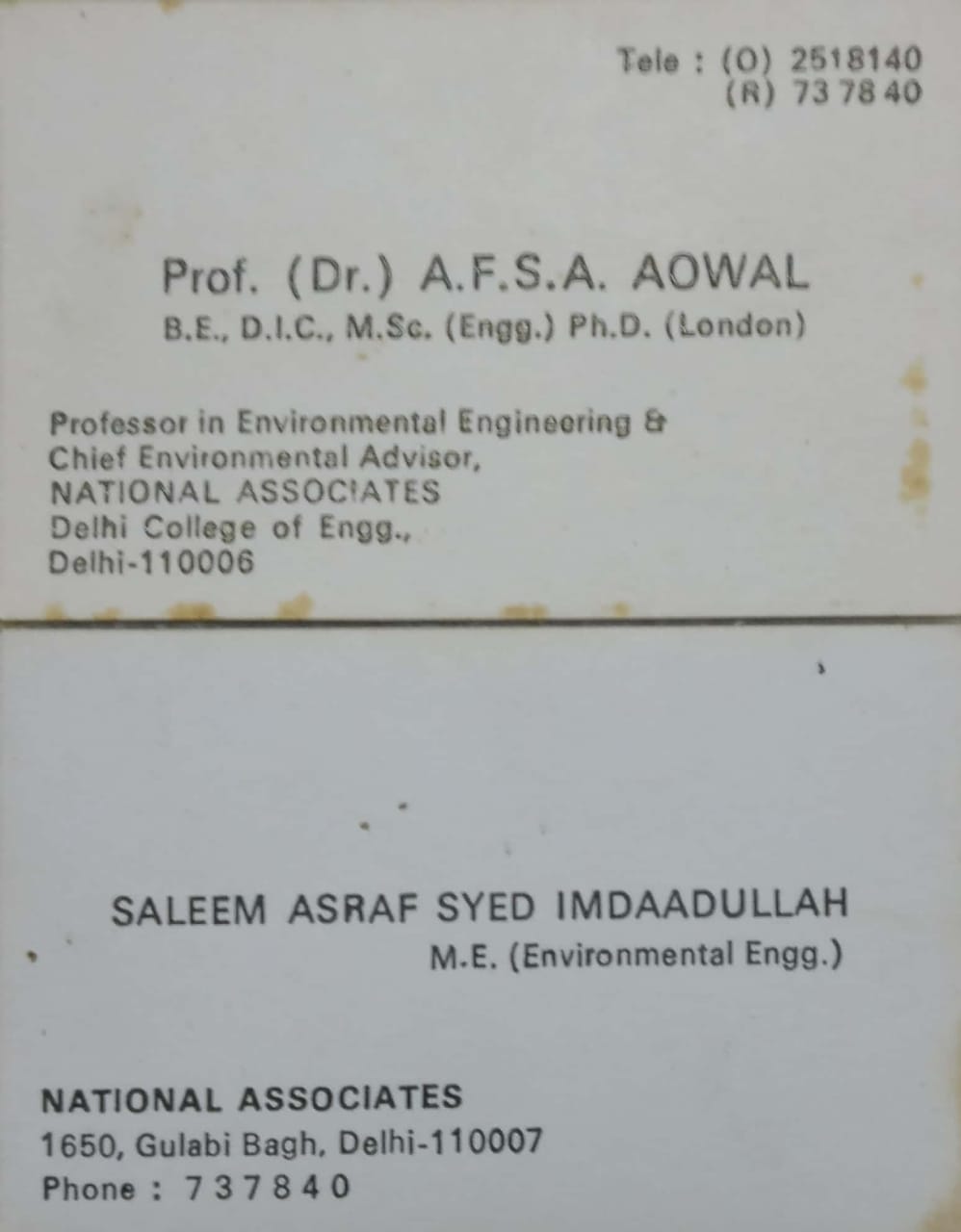
MY FIRST JOB IN HIS COMPANY NATIONAL ASSOCIATE

I HAVE LEARNED ABCD OF DESIGN FROM HIM IN HIS OWN HAND WRITTING
Executive summary
1. Early life and background
2. Education and doctoral research at Imperial College
2.1 Research problem
2.2 Hydraulic conditions considered
2.3 Mathematical and experimental methods
2.4 Relevance to water and wastewater treatment
3. Professional career
|
Period |
Position / institution |
Evidence status |
|
1961–1962 |
Junior
Engineer, Assam State Electricity Board |
Reported
in 2015 biography |
|
1962–1969 |
Lecturer,
Civil Engineering, Assam Engineering College |
Reported
in 2015 biography |
|
1969–1971 |
Assistant Professor,
Civil Engineering, Assam Engineering College |
Reported
in 2015 biography |
|
1971–1973 |
Executive
Engineer, Town and Country Planning Department, Assam |
Reported
in 2015 biography |
|
1973–1975 |
Executive
Engineer, Public Health Engineering Department, Assam |
Reported
in 2015 biography |
|
1975–1996 |
Professor,
Environmental Engineering, Delhi College of Engineering |
Reported;
retirement year also appears in 2004 announcement |
|
During DCE
career |
Reported
Head of Civil Engineering Department and Dean, Faculty of Technology,
University of Delhi |
Partly
supported by 2004 announcement |
3.2 Academic and professional responsibilities
4. Applied inventions and environmental technologies
4.1 Aowal iron eliminator for hand tube wells
4.2 Portable wastewater treatment plant for oil drilling
4.3 Electro-flocculation / electrocoagulation
4.4 Textile dye recovery
4.5 Sludge Reagent Product (SRP)
4.6 Upflow septic tank
4.7 Experimental desalination using ultrasound and electro-flocculation
5. Reconstructed engineering design philosophy
6. Academic supervision and professional associations
7. Influence and relevance to environmental engineering in India
|
Aowal's documented or reported work |
Contemporary engineering relevance |
|
Continuous-flow
mixing and hydraulic models |
Tracer
studies, residence-time distribution, hydraulic optimisation and reactor
modelling |
|
Short-circuiting
and recirculation analysis |
STP/ETP
tank design, baffle design, aeration tank hydraulics and contact tanks |
|
Iron
eliminator for hand tube wells |
Groundwater
iron removal and decentralised drinking-water treatment |
|
Electro-flocculation
device (reported) |
Electrocoagulation
research for industrial wastewater |
|
Portable
oilfield ETP (reported) |
Modular treatment
for remote industrial sites |
|
Textile
dye recovery (reported) |
Resource
recovery, colour removal and industrial water reuse |
|
Upflow
septic tank (reported) |
Decentralised
wastewater treatment and sanitation |
8. Retirement, death and remembrance
9. Overall historical and technical assessment
10. Archival research priorities
|
Priority |
Record to locate |
Likely custodian / route |
|
Very high |
Original
1981 iron-eliminator paper |
Indian
Water Works Association |
|
Very high |
DCE
service file, appointment orders and retirement record |
Delhi
Technological University archives |
|
Very high |
Patent
applications and specifications |
Indian
Patent Office / IP India database |
|
High |
SRP
formulation and treatment report |
Family
papers or consultancy archive |
|
High |
Electro-flocculation
drawings and performance reports |
Family
papers; Tamil Nadu Pollution Control Board records |
|
High |
Portable
oilfield ETP drawings and commissioning report |
Oil India
/ ONGC archives |
|
High |
Government
adoption or evaluation of Aowal Filter |
Assam
Public Health Engineering Department |
|
High |
M.E. and
PhD scholar registers |
University
of Delhi / Delhi College of Engineering records |
|
Medium |
ISI
Committee CDC-26 minutes |
Bureau of
Indian Standards archives |
|
Medium |
Consultancy
reports and committee correspondence |
CPCB and
relevant State Pollution Control Boards |
12. Sources and further reading
Useful institutional websites
Closing note
PROF DR.ABUL FAIZ SYED ABDUL AOWAL, DELHI COLLEGE OF ENGG,NEW DELHI, (BIRTH, 1938 JORHAT,ASSAM---- DEATH,2004,GUWAHATI,ASSAM), SON OF DR. SYED JAMALUR RAHMAN AND SYEDA ANWARA BEGUM.
1. POSTINGS :
(a) Junior Engineer , Assam State Electricity Board, (1961- 62)
(b) Lecturer , Civil Engg. Assam Engg. Collage , Guwahati , Govt. of Assam , (1962-69)
(c) Asstt. Professor, Civil Engg. Assam Engg. Collage, (1969-71)
(d) Executive Engineer , Town & Country Planning Deptt. Govt . of Assam , (1971-73)
(e) Executive Engineer , Public Health Engg. Deptt.., Govt. of Assam , (1973-75).
(f) Professor in Environmental Engg. Delhi College Of Engg, Delhi Administration, Delhi- 110006,since 1975 –Retired.
2. CONSULTANCY SERVICES :
Had done consultancy works in the field of pollution control as a consultant of the:
(a) National productivity council
(b) Delhi productivity council
(c) Central Board for the prevention and control of pollution (C.P.C.B.)
(d) Tamil Nadu pollution control Board
(e) U.P. pollution control Board
(f) Assam pollution control Board
(g) Haryana pollution Control Board
(h) Punjab Pollution Control Board
(i) Delhi Collage of Engg. Helping as Adviser
(j) Indian Institute of Ecology & Environment etc.
3. INVENTIONS:
The following inventions are made:-
(a) AOWAL FILTER : Design and construction of an iron eliminator for hand pumps . This design has been adopted by the P.H.E. Dett., Govt. of Assam for which he never got any official recognition from his department, but everyone knows about it..
(b) Design and Fabrication of portable Effluent Treatment Plant for waste water from Oil Drilling . This has been successfully demonstrated in the field at Duliajan , Assam to Oil India and O.N.G.C. officials.
(c) Design and febrication of an Electro- flocculation Device for colloidal waste water treatment like pulp and paper mill waste textile mill waste , tannery waste , distillery waste . This has been patronised by Tamil Nadu pollution control Board and demonstrated at Erode and coimbatore, T.N.
(d) Design and Febrication of a Dye recovery system from textile mill effluent – project patronised by D.S.I.D.D.C
(e) S.R.P (Sludge Reagent product ) method of treatment of Drinking water . This reduces cost of conventional treatment of water by half , this method is already patented.
(f) S.R.P. method of chemical Treatment of Sewage . This mothod is cheaper in capital cost equal in running cost as compared to the biological treatment and is free from odour and insect nuissance .This is also patented.
(g) A new type of upflow septic tank is designed and installed in a number of places . The biggest one is installed in the market place of Durgapur . About 12 are working for the last 10 years in Okhla, New Delhi . It requires a Soak pit , it has a far better effluent water quality and cost is 40% less than the conventional septic tank
(h) A cheap method of desalination of sea water by using ultra sound and electro flocculation . very encouraging results are seen in the lab . prototype experimentation with actual sea water is expecteed in collaboration with the Govt. of Tamilnadu.
4. OTHER ACTIVITIES:
(a) Head of Deptt. of CivilEngg. ., Delhi collage of Engg., Delhi.
(b) Guiding post Graduate and undergraduate project work . About 50 M.E. projects 2 ph. D. projects are completed .
(c) Expert of the U.P.S.C.
(d) Member Faculty of Technology , University of Delhi.
(e) Member University Court , University of Delhi.
(f) Ex Member , Academic Council , University of Delhi.
(g) Chairman , I.S.I. Committee CDC-26
(h) Ex-Dean, Faculty of technology , University of Delhi
(i) Member , Engineering courses committee , Jamia Millia Islamia,New Delhi
5. MEMBERSHIP OF PROFESSIONAL BODIES:
(a) Life Member , I.W.W.A.
(b) Member , I.A.P.C.F.
(c) Member , I.W.P.C.F.
(d) Member , I.P.H.E.
(e) Member , Bio. Soc. Ind.
HE WAS ADVISER TO MANY ENTREPRENEURS LIKE ME.

MONDAY, NOVEMBER 29, 2004Dr.A.F.S.A. Aowal is no moreA VERY SAD NEWS :
Prof. Dr. Abul Faiz Syed Abdul Aowal
(1938–2004) was an Assam-born civil and environmental engineering academic
whose documented work connected hydraulic analysis with water and wastewater
treatment. His 1969 PhD thesis, The Analysis of Mixing in Continuous Flow
Systems, was completed in the Department of Civil Engineering at Imperial
College of Science and Technology, University of London. It investigated
mixing, residence-time behaviour, short-circuiting and recirculation in
continuous-flow systems, using mathematical models and experimental work.
A later traceable contribution is his 1981
paper, Design of an Iron Eliminator for Hand Tube Wells, published in the
Journal of the Indian Water Works Association. Later technical literature cites
this design. A 2015 biographical account also attributes to him a range of
applied technologies, including a portable oilfield wastewater treatment plant,
electro-flocculation equipment, textile dye recovery, a product described as
Sludge Reagent Product (SRP), an upflow septic tank and experimental
desalination work. These additional inventions require further primary-source
verification.
The 2015 biographical account states that
Abul Faiz Syed Abdul Aowal was born in 1938 in Jorhat, Assam. It names his
parents as Dr. Syed Jamalur Rahman and Syeda Anwara Begum. The available online
material consulted for this biography does not establish his school education,
undergraduate institution, exact date of birth or complete family history.
These details are therefore not expanded beyond what the source reports.
His later professional interests included
groundwater iron removal, drinking-water treatment, industrial wastewater
treatment and sanitation. These subjects are relevant to the public-health and
infrastructure challenges faced by communities and industries in Assam and
elsewhere in India. However, the connection between his regional upbringing and
each specific invention is an interpretation, not a documented statement by Dr. A.F.S.AS.Aowal.
The institutional thesis record identifies
Aowal as the author of The Analysis of Mixing in Continuous Flow Systems,
submitted in April 1969 for the degree of Doctor of Philosophy. The work was
undertaken in the Department of Civil Engineering at Imperial College of
Science and Technology, University of London. The thesis front matter records
the qualifications B.E., D.I.C. and M.Sc. (Eng.) (London), names F. E. Bruce as
supervisor, and acknowledges an Overseas Scholarship from the Government of
Assam.
The nominal hydraulic retention time of a
treatment tank is commonly calculated as HRT = V/Q, where V is the effective
volume and Q is the flow rate. This calculation alone does not reveal how water
actually moves through a tank. Real systems may exhibit short-circuiting, recirculation,
stagnant regions and non-uniform mixing. Consequently, some water may leave
much earlier than the nominal retention time, while other portions remain in
the system for longer periods.
Aowal's thesis examined how these hydraulic
behaviours could be represented mathematically and assessed using experimental
tracer-response information.
·
Plug flow: fluid elements move
through a reactor with limited longitudinal mixing.
·
Complete mixing: the tank
contents are treated as homogeneous, with the outlet concentration
corresponding to the mixed tank contents.
·
Short-circuiting: part of the
influent reaches the outlet through a faster-than-intended path.
·
Recirculation: internal
circulation changes the distribution of residence times.
·
Stagnant or poorly exchanged
regions: parts of the nominal tank volume contribute less to effective
treatment.
The thesis developed six mathematical
models using control-system concepts and examined their behaviour through
transfer functions, block diagrams, Laplace-transform methods and parameter
estimation. The work used tracer response, including pulse-response techniques,
and considered linear programming and analogue computation. Experimental arrangements
included turbulent flow through a tube and a diffused aeration tank. The models
were compared with measured responses, with the thesis reporting reasonably
good agreement for the cases studied.
The importance of this approach lies in the
combination of mathematical representation and experimental verification. It is
an early example of applying quantitative system analysis to hydraulic
behaviour relevant to public-health engineering.
The thesis discussed possible uses of the
proposed models in water and sewage treatment. Applications included chlorine
contact tanks, sedimentation tanks, activated-sludge systems, nitrification
units, oxidation ponds and natural water bodies such as lakes and river reaches.
For chlorine contact tanks, the work discussed the value of assessing the
actual residence-time behaviour rather than relying only on nominal tank volume
and flow.
A particularly sound feature of the thesis
is its recognition of limitations. It noted that the hydraulic models did not,
by themselves, fully account for changes in chemical constituents or reaction
kinetics. It proposed future work coupling hydraulic models with reaction
equations to predict outlet concentrations.
The career chronology below is reported in
the 2015 biographical account. The 2004 announcement independently supports his
identification as a former Professor and Head of Civil Engineering at Delhi
College of Engineering and gives 1996 as his retirement year.
His reported work in Town and Country
Planning and Public Health Engineering preceded his move to Delhi College of
Engineering. These appointments would have exposed him to urban infrastructure,
water supply, sanitation, drainage and public-health engineering. This
background is consistent with the practical orientation of his later reported
environmental engineering work, although individual project responsibilities
require archival confirmation.
The biographical account reports that he
served as Head of the Civil Engineering Department and Dean of the Faculty of
Technology at the University of Delhi. It also records membership or
association with the University of Delhi Academic Council and University Court,
the Jamia Millia Islamia engineering courses committee, and
technical/professional bodies. A contemporaneous 2004 announcement identifies
him as Professor and Head of Civil Engineering at DCE and Dean, Faculty of
Technology.
The following technologies are attributed
to Aowal by the 2015 biographical account. Except for the iron eliminator, for
which a published paper and later citations are identifiable, the original
patents, drawings, process reports and performance data were not located in the
research material used here. Descriptions of process mechanisms below are
engineering interpretations and should not be mistaken for verified details of
his original designs.
A traceable publication associated with
Aowal is Design of an Iron Eliminator for Hand Tube Wells, reported as
published in 1981 in the Journal of the Indian Water Works Association, Volume
XIII, Issue 1. Later technical literature cites this design. The biographical
account describes a compact arrangement for iron-bearing groundwater involving
spray aeration, settling and plain sand filtration.
The underlying treatment principle is
oxidation of dissolved ferrous iron (Fe2+) to ferric iron, followed by
precipitation and physical removal. A simplified oxidation/precipitation
reaction is:
4Fe²⁺ + O₂ + 10H₂O → 4Fe(OH)₃ + 8H⁺
The ferric hydroxide precipitate can be
separated by settling and filtration. A later 2024 technical paper discusses
operational limitations associated with the cited design, including a filter
run reported to be less than 24 hours and the need to clean the upper fine-sand
layer. This is a useful reminder that filter run length, maintenance burden and
operator requirements are as important as initial removal efficiency.
The 2015 account reports that Aowal
designed and fabricated a portable treatment plant for wastewater generated
during oil drilling operations, with a demonstration at Duliajan before Oil
India and ONGC representatives. The original capacity, process-flow diagram,
influent analysis, treated-water results and commissioning records were not
located.
From an engineering perspective, oilfield
wastewater may contain suspended solids, oil and grease, dissolved salts,
drilling-fluid residues and chemical additives. A portable treatment system
must accommodate variable influent quality, limited site infrastructure,
transport constraints and safe residuals management. Screening, oil separation,
chemical treatment, settling and filtration are possible unit operations, but
the exact process used in Aowal's plant remains unverified.
The biography attributes to Aowal an
electro-flocculation device intended for colloidal wastewater, with reported
applications in pulp and paper, textile, tannery and distillery sectors. It
also mentions demonstrations in Erode and Coimbatore and an association with
the Tamil Nadu Pollution Control Board. No original electrode design or
performance report was located.
In modern electrocoagulation, sacrificial
electrodes—commonly aluminium or iron—release metal ions that hydrolyse and
form hydroxide species. These can destabilise colloids and assist floc
formation. Hydrogen bubbles generated at the cathode may aid flotation.
Performance depends on electrode material, current density, pH, conductivity,
residence time, passivation, sludge production and electrical energy
consumption.
Al → Al³⁺ + 3e⁻
2H₂O + 2e⁻ → H₂ + 2OH⁻
These equations describe a common aluminium
electrocoagulation system; they are explanatory modern chemistry, not a claim
that Aowal used this exact electrode arrangement.
The biographical account reports a
dye-recovery system for textile mill effluent, with support from the Delhi
State Industrial Development Corporation (DSIDC). A recovery-oriented process
could potentially reduce colour discharge and reclaim useful material.
Verification would require the dye types, separation method, recovered dye
purity, colour strength, reuse trials, chemical consumption and energy balance.
No original technical report or recovery data were located.
The biography describes a product called
Sludge Reagent Product (SRP), reportedly developed for drinking-water treatment
and later applied to sewage treatment. It claims a reduction of approximately
50% in conventional treatment costs. The chemical composition, preparation
method, dosage, mechanism, water-quality results and cost-comparison basis are
not available in the sources consulted. It would be inappropriate to infer its
composition or describe it as a particular coagulant without the original
formulation.
A separate upflow septic tank design is
also attributed to Aowal. The biography reports installations in Durgapur and
approximately twelve installations in Okhla, Delhi, and claims construction
costs around 40% below conventional septic tanks. These figures require
confirmation through drawings, site records and comparative bills of
quantities.
A technical assessment of such a system
should examine hydraulic loading, effective retention time, upflow velocity,
sludge storage, scum retention, gas venting, desludging access, structural
integrity and groundwater protection. Lower capital cost alone does not
establish equivalent treatment or safe operation.
The biography reports experimental work on
seawater desalination using ultrasound and electro-flocculation. This claim
should be treated cautiously. Electro-flocculation and ultrasound may assist
pretreatment or removal of selected contaminants, but desalination requires
removal of dissolved salts. Without feed and product TDS, salt rejection,
energy consumption, recovery and a complete mass balance, the work cannot be
described as a demonstrated alternative to reverse osmosis or thermal
desalination.
No formal statement of Aowal's design
philosophy has been located. The following principles are an analytical
reconstruction from his thesis and reported applied work, not direct quotations
or a manifesto written by him.
·
Understand real process behaviour: His
thesis investigated actual flow patterns rather than assuming that nominal tank
volume and flow fully describe treatment performance.
·
Validate models experimentally: He
combined mathematical models with tracer-response measurements and experimental
arrangements.
·
Translate theory into practical equipment: The reported iron eliminator, portable ETP and electro-flocculation
device suggest an interest in implementable treatment systems.
·
Adapt designs to local problems: The
reported hand-tube-well iron treatment and oilfield plant addressed specific
water-quality and site conditions.
·
Integrate unit operations where appropriate: The reported compact iron-removal arrangement combined aeration,
settling and filtration; integration must still preserve maintainability and
process control.
·
Consider lifecycle economics: The
reported SRP and septic tank work emphasised affordability, although the
claimed savings require verification.
·
Recognise limitations and research needs: The thesis identified the need to incorporate reaction kinetics and
improve field validation rather than treating hydraulic models as complete
treatment models.
The 2015 biography reports that Aowal
guided approximately 50 M.E. projects and supervised two PhD projects. It also
reports an expert association with UPSC and chairmanship of ISI Committee
CDC-26. These details should be checked against university research registers,
committee records and appointment documents.
The same account lists associations or
memberships with the Indian Water Works Association, Indian Association for
Pollution Control Federation, Indian Water Pollution Control Federation,
Institution of Public Health Engineers, India, and Bioscience Society of India.
Membership dates and categories have not been independently verified.
The most firmly evidenced influence is
intellectual and technical: his doctoral work connected hydraulic analysis with
public-health engineering applications, and his 1981 iron-eliminator paper
entered the technical literature and was cited by later researchers. His
reported academic leadership and consultancy work suggest a broader
professional role, but the extent of national adoption of his inventions cannot
be quantified from the available online evidence.
Consider a hypothetical 500 KLD sewage
treatment plant with an aeration tank volume of 1,000 m³. At an average flow of
500 m³/day, the nominal HRT is:
HRT = V / Q = 1,000 / 500 = 2 days = 48 hours
This nominal value does not prove that
every part of the flow receives 48 hours of treatment. A tracer test could
identify early breakthrough, broad residence-time distribution or a long tracer
tail. Engineers could then investigate inlet/outlet geometry, baffles, aerator
placement, tank configuration and hydraulic distribution. This example
illustrates the continuing relevance of Aowal's research approach; it is not a
calculation taken from his thesis.
A contemporaneous announcement dated 29
November 2004 reports that Aowal died in Guwahati at approximately 5:30 p.m. It
identifies him as a former Professor and Head of Civil Engineering at Delhi
College of Engineering and Dean of the Faculty of Technology, University of
Delhi. The same announcement gives 1996 as his retirement year. The 2015
biographical account also records his death on 29 November 2004.
The 2004 material includes a condolence
message dated 30 November 2004. This is useful contemporaneous remembrance
material, but it is not a substitute for an official death certificate or
newspaper obituary.
Aowal's most substantial verifiable
academic contribution is his 1969 doctoral research on mixing in continuous
flow systems. It shows an early and technically developed attempt to model
hydraulic behaviour relevant to water and sewage treatment. Its enduring value
lies in the recognition that actual reactor hydraulics—not nominal retention
time alone—affect treatment performance.
His 1981 iron-eliminator publication provides
a second identifiable contribution to Indian water-treatment engineering. Later
citations and technical discussion show that the design remained part of the
literature. The other inventions described in the biographical archive are
potentially important, but require original technical records before claims
about performance, adoption, patents or cost savings can be treated as
established.
A balanced historical description is
therefore that Prof. Dr. Aowal was an early contributor to applied environmental
engineering and treatment-process research in India, combining academic work,
government engineering experience, teaching and reported technology
development. The available evidence does not justify an unsupported national
ranking or a claim that all reported inventions achieved widespread commercial
adoption.
A permanent digital collection could be
established under the title: The Prof. Dr. Abul Faiz Syed Abdul Aowal Memorial
Archive – Environmental Engineering and Water Technology. The archive should
preserve:
·
His complete academic biography
and verified career chronology.
·
The Imperial College doctoral
thesis and any related research papers.
·
The original 1981
iron-eliminator publication.
·
Patents, invention disclosures,
process-flow diagrams and engineering drawings.
·
Consultancy reports, government
correspondence and project performance data.
·
Photographs from Assam
Engineering College and Delhi College of Engineering.
·
Oral-history interviews with
former students, colleagues and collaborators.
·
A technical review comparing
his designs with current environmental engineering standards.
The archive should retain scans of original
documents, record their provenance, distinguish recollections from official
records, and avoid presenting unverified claims as established facts.
1. Imperial College London
institutional repository. Catalogue record for Abul
Faiz Syed Abdul Aowal's 1969 doctoral thesis, The Analysis of Mixing in
Continuous Flow Systems.
2. Original doctoral thesis. The Analysis of Mixing in Continuous Flow Systems, Imperial College
of Science and Technology, University of London, April 1969. 266 pages.
3. SALEEM INDIA biographical
account. Prof. Dr. Abul Faiz Syed Abdul Aowal – biographical
account published 7 July 2015; source for reported career details, inventions,
photographs and family information.
4. Contemporaneous
announcement. Announcement dated 29 November 2004
reporting his death and identifying his former DCE and University of Delhi
roles.
5. Journal of the Indian
Water Works Association. A. F. S. A. Aowal, Design
of an Iron Eliminator for Hand Tube Wells, 1981, Volume XIII, Issue 1. Exact
pagination should be checked against the original issue.
6. River Research Institute
technical literature, 2024. Later technical
discussion citing Aowal's iron-eliminator design and reporting operational
observations.
·
Delhi Technological University
(formerly Delhi College of Engineering): https://dtu.ac.in/
·
University of Delhi:
https://www.du.ac.in/
·
Bureau of Indian Standards:
https://www.bis.gov.in/
·
Central Pollution Control
Board: https://cpcb.nic.in/
·
Imperial College London:
https://www.imperial.ac.uk/
Dr.A.F.S.A. Aowal is no more.He passed away this evening at 05-30 at
guwahati,assam.----- Original Message -----
From:
To: saleem
Sent: Tuesday, November 30, 2004 10:09 AM
Subject: Re: Dr.A.F.S.A. Aowal is no more.
> Asalaamu Alaikum,
> Ina Lillahi Wa Ina Ilaihi Rajioon !
> We are shocked and distressed to hear of this news.
> My father Haji M Miakhan is quite upset at hearing of this news.
> We have very fond memories of Dr Aowal that cannot be forgotten, ever.
> We pray that the Almighty give him peace and tranquility forever.
> Since my father is not keeping well, kindly convery our heartfelt
condolencences
> to his family.
> Haji M Miakhan
> Khan Md Ashraf
Dr.A.F.S.A. Aowal is no more.He passed away this evening at 05-30 at
guwahati,assam.
From:
To: saleem
Sent: Tuesday, November 30, 2004 10:09 AM
Subject: Re: Dr.A.F.S.A. Aowal is no more.
> Asalaamu Alaikum,
> Ina Lillahi Wa Ina Ilaihi Rajioon !
> We are shocked and distressed to hear of this news.
> My father Haji M Miakhan is quite upset at hearing of this news.
> We have very fond memories of Dr Aowal that cannot be forgotten, ever.
> We pray that the Almighty give him peace and tranquility forever.
> Since my father is not keeping well, kindly convery our heartfelt
condolencences
> to his family.
> Haji M Miakhan
> Khan Md Ashraf